Let's Talk
+44 (0) 121 511 0400
ipu@ipu.co.uk
IPU Group
Log in
Quote
ContactsContact us
  • Home Page
  • Explore IPU
  • Tank Cleaning
  • Your Industry
    • Marine Industry
    • Oil & Gas Industry
    • Mining
    • Healthcare
    • Data Centres & IT Services
    • Power Generation
  • IPU Academy
  • Fuel Management Services
    • Case Studies
    • HMRC Red Diesel Rebate Changes
    • IPU Fuel Conditioning Programmes
    • Diesel Testing โ€“ DieselCheck Service & Kits
    • Fuel Cleaning Services โ€“ ClearTank diesel cleaning
    • Fuel Tank Cleaning
    • Fuel Polishing Systems โ€“ Diesel Defence
    • Diesel Defence Servicing
    • Cloud Based Fuel Monitoring
    • Fuel Polishing Hire
    • Diesel Defender Fuel Additive
    • Baldwin Filters
    • Parker Racor Filtration
    • Donaldson Filters
    • Supporting Fuel Conditioning Products
    • What is Diesel Contamination?
    • Fuel Conditioning Contacts
  • Environmental Services
    • OFTEC Inspection services
    • MCERTS Emissions Gas Testing
    • Total Fuel Management
  • Case Studies
  • Servicing
  • Emissions Reductions
    • Case Studies
    • IPU Emissions Solutions
    • Selective Catalytic Reduction system (SCR)
    • Diesel Particulate Filter for gensets (DPF)
    • Latest Emissions Legislation: MCPD and NRMM
    • Clean Air Zones
    • Stack Modelling
    • What is NOx?
    • What is Particulate Matter?
  • CAN Bus Solutions
    • Senquip Telemetry ORBs
    • Enovation Engine and Genset Battery Chargers
    • Enovation J1939 Input/Output Modules
    • Enovation CAN J1939 PowerView Gauges
    • Enovation Process Monitoring Instruments
  • Displays
  • Filtration
    • Parker Racor Filtration
    • Baldwin Filters
    • Donaldson Filters
  • Component Sourcing
    • Single Sourcing
    • Specialist Component Sourcing
    • Engine Manufacture
    • Oil Industry Supply Company
    • Marine Engine Service Company
  • Manufacturing Services
    • IPU Sub-Assemblies
  • Case Studies
  • About IPU
    • About Us
    • Our capabilities
    • Our Distributors
    • IPUโ€™s COVID-19 Response
    • Meet the Management Team
    • IPU Finance Options
    • Contact Us
    • Our History
    • Quality & Environmental
    • Modern Slavery Policy
    • Careers
    • News
    • Compliments & Complaints
  • Contact Us
  • Downloads
  • News
  • All Products

Home ยป ATEX Directive: What is ATEX? ยป ATEX Zone 20

ATEX Zone 20

The ATEX 137 Workplace Directiveย (Directive 99/92/EC) defines safety standards that apply to different levels of dangerous working environments. The more dangerous the environment, the more stringent the requirements.ย ATEX Zone 20 is one of the two most dangerous zoning classifications.

Many workplaces may contain or produce explosive atmospheres. Examples include:

  • places where the work creates or releases flammable gases or vapours (e.g. paint spraying)
  • places handling fine organic dustsย (e.g. grain storage and woodworking)
  • underground mines (for dust)
  • oil and gas (for vapour)
ATEX Zone 20 and ATEX Zone 0 represent the most dangerous workplace environments

ATEX Zone 20 and ATEX Zone 0 represent the most dangerous workplace environments

ATEX uses Zone numbers to distinguish between environments with differentย levels of danger. It is an employer’s responsibility to correctly classify the workplaces for which they are responsible. The classification given to a zone depends on the likelihood of an explosive atmosphere occurring and its persistence if it does. ATEX distinguishes between explosive atmospheres that arise because of gases, vapours and mists and those that arise from dusts.
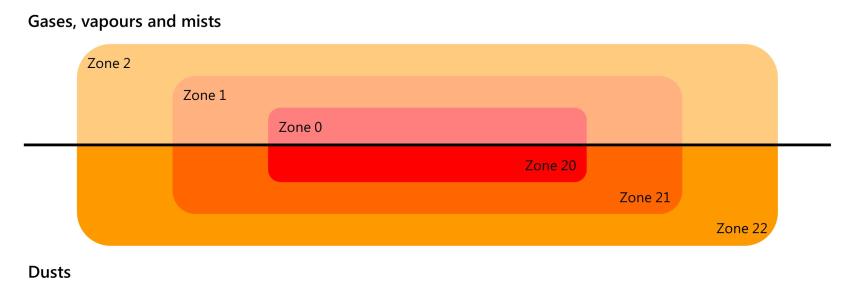
ATEX Zone 20 is the most hazardous workplace type where explosive dusts are present.

ATEX Zone 20 is the most hazardous workplace type where explosive dusts are present.

The zone classifications for gases, vapours and mists are directly relevant to oil and gasย platforms, drilling rigs and storage facilities.

Gases, vapours and mists
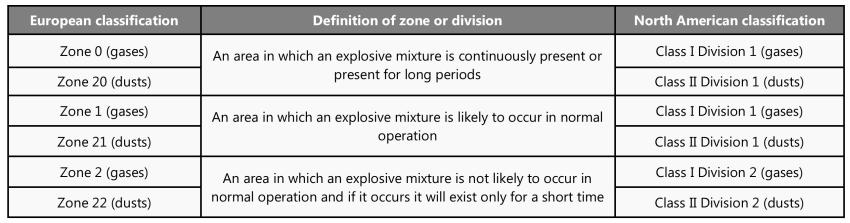
Zone 0 A place in which an explosive atmosphere consisting of a mixture with air of dangerous substances in the form of gas, vapour or mist is present continuously or for long periods or frequently.
Zone 1 A place in which an explosive atmosphere consisting of a mixture with air of dangerous substances in the form of gas, vapour or mist is likely to occur in normal operation occasionally.
Zone 2 A place in which an explosive atmosphere consisting of a mixture with air of dangerous substances in the form of gas, vapour or mist is not likely to occur in normal operation but, if it does occur, will persist for a short period only

The zone classifications for dusts are pertinent to underground mines.

Dusts
Zone 20 A place in which an explosive atmosphere in the form of a cloud of combustible dust in air is present continuously, or for long periods or frequently.
Zone 21 A place in which an explosive atmosphere in the form of a cloud of combustible dust in air is likely to occur in normal operation occasionally.
Zone 22 A place in which an explosive atmosphere in the form of a cloud of combustible dust in air is not likely to occur in normal operation but, if it does occur, will persist for a short period only.


IPU and ATEX Zone 20

IPU works extensively with customers in the mining industry. We supply engine starting systems for underground mining operations around the world. These air and hydraulic-powered systems are fitted to winches, fire pumps, free-steer vehicles (FSVs), compressors and vehicles. This environment falls under ATEX Zone 20, theย most dangerous environment recognised under the regulations.

Get your free handbook

  • Choosing the right starting system for CAT engines

    An easy reference guide for selecting the best starting system for your engine.

Contacts

Downloads(no ID req'd)

  • EU Directive 99/92/EC (ATEX 137, the ATEX Workplace Directive)
  • IPU ATEX Handbook
  • EU Directive 99/92/EC, Application Guidelines (ATEX 137, the ATEX Workplace Directive)
  • EU Directive 2014/34/EC, Application Guidelines (ATEX update)
  • This field is for validation purposes and should be left unchanged.
IPU Group

Registered in England & Wales: 12167631

WASP Industrial Power Units Ltd
Navigation Way
West Bromwich
West Midlands
B70 9DF, UK

Contact us
+44 (0) 121 511 0400
+44 (0) 121 511 0401
ipu@ipu.co.uk
Links
  • Homepage
  • Product Registration
  • Product Manuals
  • Terms & Conditions of Sales
  • Privacy & Cookies

ENGINE STARTING DIVISION ACQUIRED

Industrial Power Units Ltd. of the United Kingdom (IPU Group Ltd) has concluded an acquisition to sell its Engine Starting Division to an international group of companies. This sale concluded in September 2024.

Following the sale, the Engine Starting division of IPU Ltd is now Powerstart Limited, and will be managed by David Caddick (previous Sales and Technical Director of IPU).

The full range of engine starting products, including starter motors and bespoke systems, are now available through Powerstart Limited.

IPU will continue to provide an ever-expanding range of fuel polishers & maintenance products and emissions gas testing, and remain premier distributors for several global brands.

Please select whether to be redirected to our new partner site Powerstart Limited or stay on the IPU website.

Go to Powerstart Stay on IPU